
Demilec Attic Insulation in Whitney: A Homeowner’s Guide
Most Whitney homeowners don’t come to us asking for Demilec by name. They come asking why the upstairs bedroom runs hot, then they get quotes – and one contractor pushes closed-cell foam at $4 per board foot while another waves a generic “premium spray foam” line item. Demilec is a real product line with real performance specs, and it’s the right answer in some Whitney attics and an expensive mismatch in others. This guide explains which is which.
What Makes Demilec Different From Generic Spray Foam?
Demilec is a spray foam brand, not a single product, and the products are engineered to different performance curves rather than being one foam sold under different stickers. Three things separate the line from commodity foam.
- HFO blowing agents. Demilec’s modern closed-cell products use hydrofluoroolefin blowing agents rather than older HFC chemistry. The practical effect is lower global warming potential and better long-term cell-gas retention than foams blended with legacy agents.
- Dimensional stability in high-heat attics. A Whitney attic ceiling deck can run punishingly hot in summer. Closed-cell foam that isn’t dimensionally stable can shrink away from framing and open gaps over time. Demilec’s closed-cell formulations are tested for stability at elevated temperature, which is exactly the environment a Whitney roof cavity delivers.
- Third-party tested R-value retention. Foam R-values drift as cell gas ages. Demilec publishes aged R-values from independent lab testing rather than quoting only the fresh-cure number.
The headline figure is Heatlok Soy 200+ closed-cell foam at a published R-value of 6.8 per inch. That’s meaningfully higher than most competitors at the same thickness. In a Whitney attic with limited rafter depth, that number does real work.
Where Demilec Closed-Cell Foam Is Genuinely the Right Choice in Whitney
Two Whitney attic situations make Demilec closed-cell foam a genuinely superior choice rather than a premium upsell.
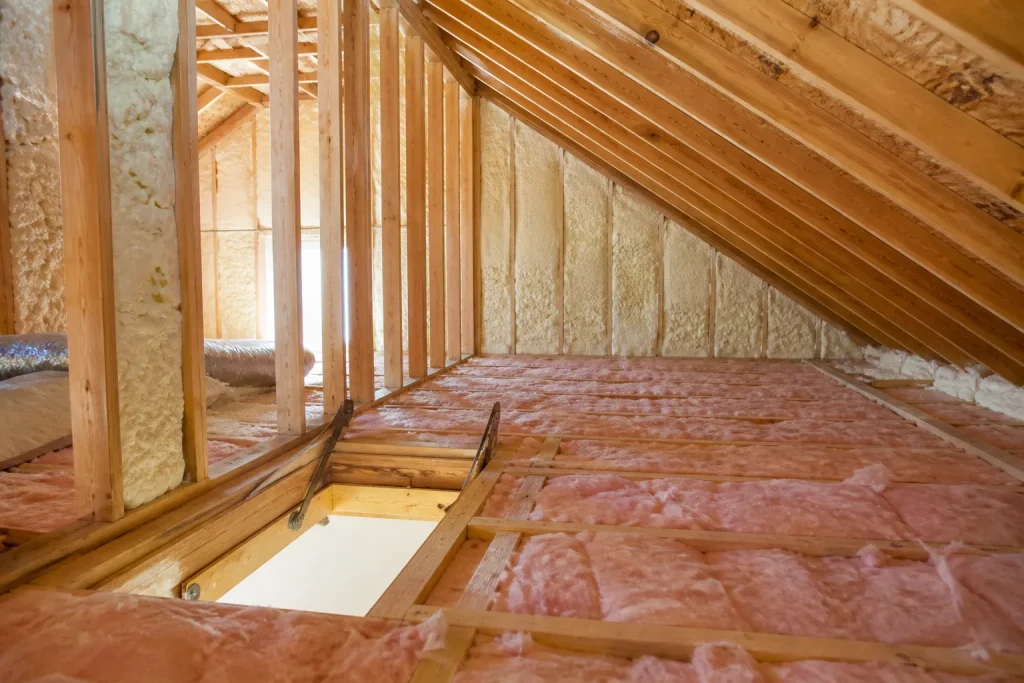
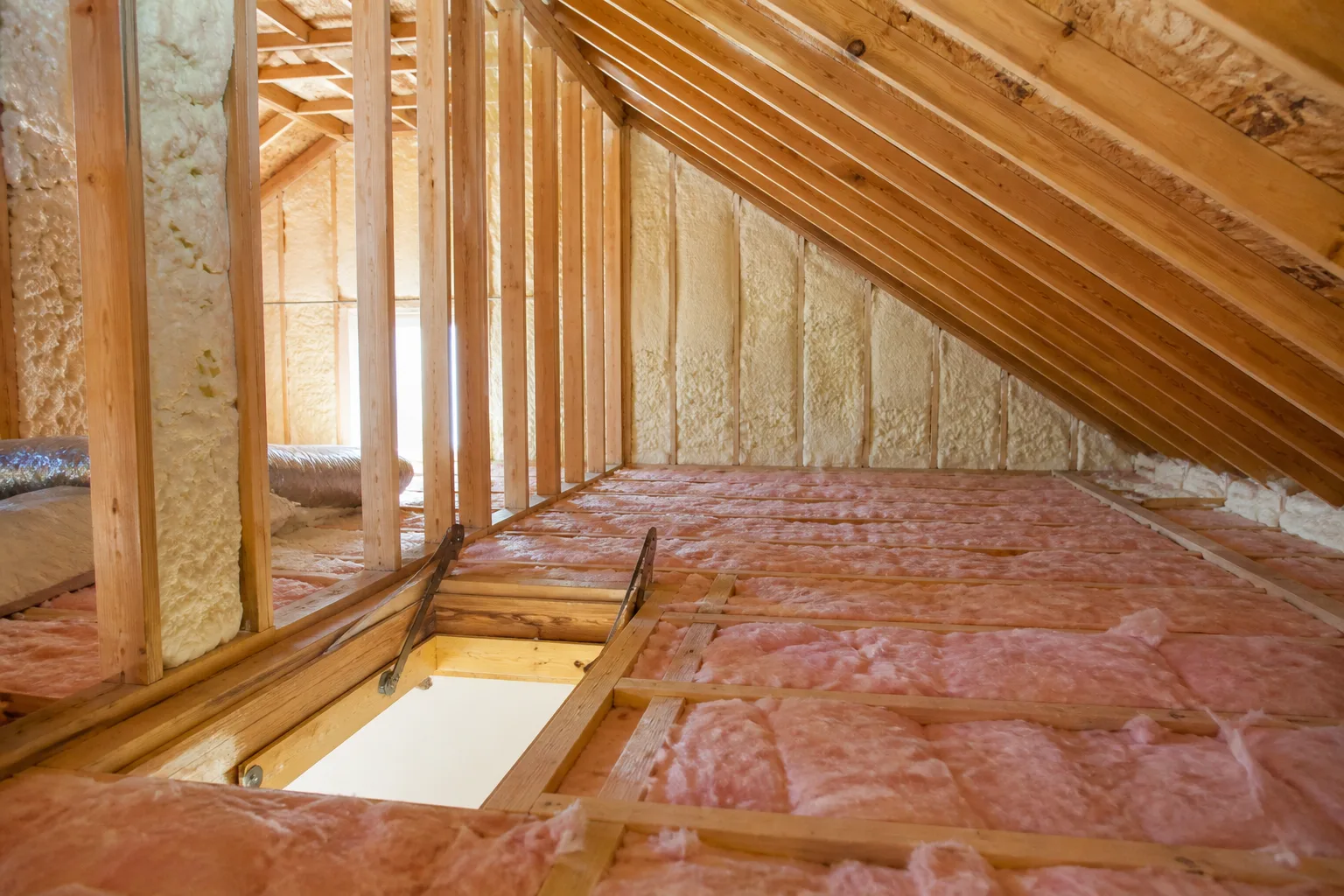
Shallow rafter bays in conditioned attic conversions. When a Whitney homeowner finishes an attic space or moves the thermal boundary to the roof line, there’s a hard depth limit: whatever fits between the deck and the ceiling. There’s no room to compensate for a lower R-value per inch with more thickness. At 6.8 per inch, a closed-cell Demilec product gets you to target performance in a bay that won’t accept enough fiberglass to do the same job. Batts from CertainTeed or Knauf can reach strong numbers, but not in a cavity that’s three or four inches deep.
Unvented cathedral ceiling assemblies. Vaulted ceilings with no vent channel behind them are a bad fit for porous insulation unless the assembly is built out carefully – you need air-impermeable material and you need it to seal seams, penetrations and framing gaps. Closed-cell spray foam delivered through our spray foam insulation work handles both in a single pass: it air-seals and insulates at once, and it adds structural rigidity to the assembly. Demilec closed-cell is a strong fit here, and the roof section is then checked with the city’s building department during the estimate to confirm the assembly meets what’s required.
Both scenarios share a trait: no space to spare. That’s when paying for performance per inch is the right call.
Where Demilec Open-Cell Fits – and Where It Doesn’t Win
Demilec’s open-cell products are a different animal, and homeowners often confuse the two. Open-cell foam lands around half the R-value per inch of the closed-cell line and is far softer and more vapor-permeable. It’s excellent for air-sealing irregular cavities, filling around penetrations and sound-deadening interior walls. In a Whitney attic with plenty of depth, open-cell foam can be a reasonable air-sealing layer.
But on a cost-per-R-value basis in a standard vented Whitney attic, it usually loses. Here’s the honest comparison:
- Blown-in fiberglass or cellulose – lowest cost per R installed, quickest to apply, and easy to top off later if you want to add more. In a deep, open, vented attic, this is usually the sensible choice and our technicians install it from Johns Manville, CertainTeed and GreenFiber.
- Demilec open-cell – better air-sealing than loose fill, but you pay spray-foam labor and material rates for a thermal value that loose fill beats on cost. Worth it when air-sealing is the real problem, not thermal resistance.
- Demilec closed-cell – highest performance per inch, highest cost, correct answer only when depth is constrained.
If your Whitney attic is a wide, open, vented space with room for fifteen or twenty inches of loose fill, closed-cell foam is a premium you don’t need. The insulation detail is part of our attic insulation assessment, and the right material is the one that fits your attic’s shape, not the one that sounds most advanced.
What a Demilec Installation Actually Involves in a Whitney Home
Spray foam is a scheduled job with a real sequence, and knowing it helps you plan. The job starts with a free estimate visit – we measure the attic, check rafter depth, look at venting and existing insulation, and confirm what the city’s building department will require for your assembly. You get a written estimate with the price set per job before anything is ordered.
On install day, the sequence looks like this:
- Prep. The attic gets masked, floors and HVAC equipment protected, and occupants and pets cleared out of the work zone.
- Spray application. Material goes down in passes to the target thickness. Closed-cell is applied in thinner lifts than open-cell because it reacts and expands differently.
- Cure and off-gassing. There’s a smell during cure – a musty, chemical odor that fades as the foam sets. Expect to stay out of the attic for the re-entry window the installer states, typically several hours.
- Trim and inspection. Excess foam is trimmed, the surface checked, and the space reviewed against the plan.
For a typical Whitney single-story home with a straightforward attic, plan on installation as a one-day project for the foam work alone, with cure and re-entry on top of that. Cathedral ceiling assemblies and complex rooflines take longer. The schedule gets confirmed at the written estimate, which is the one number that sets the final price.
How to Verify You’re Getting Genuine Demilec Product
Spray foam is mixed on-site from two drums, which makes substitution easy and hard to spot. Anyone can call a drum “premium closed-cell foam.” Before you sign, ask these questions:
- Which Demilec product, specifically? Heatlok Soy 200+ is not the same as the open-cell line. Get the product name in the written estimate, not just “Demilec.”
- Can I see the labeled drums or pails before application? Genuine product is labeled with the manufacturer name, product name and lot information. A contractor who won’t show the labeled container is telling you something.
- What does the labeled R-value per inch say, and is it aged or fresh-cure? Ask for the aged figure.
- Will you give me the manufacturer’s technical data sheet? Every real Demilec product has one. It lists the exact R-value, density and application limits.
- What’s the re-entry time stated on the label? The number should match the manufacturer’s data, not a guess.
Our technicians have up to 9 years of experience, and they’ve seen enough attics in Whitney to know when a homeowner is being sold a product that doesn’t match the space. If you’re comparing quotes and something feels off, call us for a second free estimate.
When to Call a Pro (and When Not To)
This is not a project to tackle yourself. Spray foam involves isocyanate chemistry, high-pressure equipment and a full-body PPE setup, and applying it wrong – particularly in an unvented or cathedral ceiling assembly where vapor movement matters – can trap moisture or fail inspection. There’s no safe DIY version of a spray foam application.
Loose-fill is a different story, but even there, air-sealing before you add insulation is the step that makes the biggest difference, and it’s often missed. If you’re comfortable checking the depth of existing insulation against a straight edge and shining a light on gaps around recessed fixtures and top plates, you can learn a lot. When it’s time to do the work, get an assessment. We handle spray foam, blown-in and batt installations across eight manufacturer brands including Demilec and Icynene, so the material gets matched to your attic rather than your attic getting shaped around a single product.
Related services in Whitney: we install Attic Insulation Whitney, blown-in insulation and Demilec and Icynene spray foam systems. If you’re not sure which fits, that’s exactly what the estimate answers.
The Bottom Line
Demilec is a genuinely strong product line, not marketing. Heatlok Soy 200+ at 6.8 R per inch is the right call for shallow rafter bays and unvented cathedral ceilings in Whitney, where every inch of depth counts. In a standard vented Whitney attic with room to spare, blown fiberglass or recycled cellulose usually gets you to the same comfort at lower cost. The right material for your attic is not the same as the one a contractor happens to stock, and that’s where an insulation specialist earns their estimate.
If you’re in Whitney and need help deciding, Attic Insulation Whitney offers free estimates – call (844) 320-7586. We answer 24/7. Fast dispatch from 7am to 7pm, Sunday through Friday. The estimate visit comes first, then a written price, then a booked install day.
Frequently Asked Questions
Spray foam in Whitney is priced per job by the written estimate, because cost depends on square footage, rafter depth, access and whether the attic is vented or unvented. Closed-cell runs higher than open-cell or blown-in because of material and application rates. Call (844) 320-7586 for a free estimate with a specific written price for your attic.
Yes, there’s a distinct odor during cure that fades as the foam sets. It’s part of the off-gassing process and typically clears within a few hours. You’ll be given a re-entry window on install day and should plan to be out of the attic until it passes. The label data sheet gives the exact figure for the specific product.
It depends on your attic. In an unvented cathedral ceiling or a shallow rafter bay where every inch of depth is limited, closed-cell’s 6.8 R per inch is worth the cost. In a standard vented Whitney attic with plenty of depth, blown fiberglass or cellulose usually gets you to target performance for less. The free estimate settles which category your attic falls into.
Plan on one install day for the foam work on a standard single-story Whitney attic, plus several hours of cure and re-entry time. Cathedral ceiling assemblies and complex rooflines take longer. The full schedule is confirmed at the written estimate, which also sets the final price – call (844) 320-7586. We answer 24/7. Fast dispatch from 7am to 7pm, Sunday through Friday.
Written by the team at Attic Insulation Whitney.
Need Insulation Help?
Call Attic Insulation Whitney - licensed & insured, here with fast help in Whitney.
(844) 320-7586